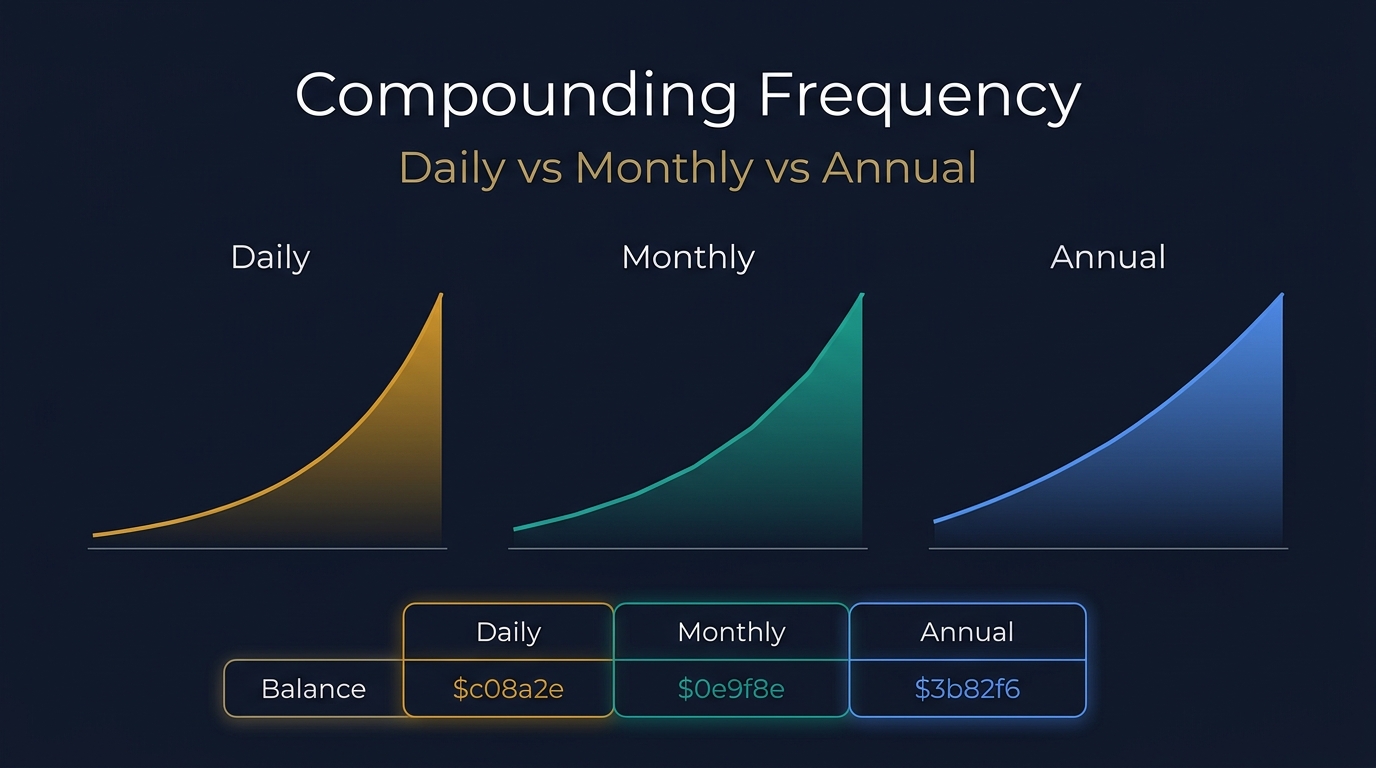
Most people assume the interest rate is the number that matters most when they’re choosing a savings account, comparing mortgage offers, or sizing up an investment. The rate does matter — but it’s not the whole story. Compounding frequency is the quiet variable that can meaningfully change what you earn or owe, even when the headline rate stays identical.
This guide breaks down exactly how daily, monthly, and annual compounding differ, where each one tends to show up in the real world, how often mortgage interest is compounded versus how often savings interest compounds, and how to figure out which frequency is actually working for — or against — you.
What Compounding Frequency Actually Means
Every time interest compounds, it gets added to your principal. From that point on, you’re earning (or paying) interest on a slightly larger balance. Compounding frequency is simply how often that addition happens within a year.
- Annual compounding — interest is calculated once per year and added to the balance at the end of the year.
- Monthly compounding — interest is calculated twelve times per year and added at the end of each month.
- Daily compounding — interest is calculated 365 times per year and added every single day.
The underlying annual rate doesn’t change. What changes is how often the math gets run, and each time it runs, the next calculation starts from a slightly higher base.
If you’re the saver, you want compounding to happen as often as possible — more frequent compounding means your interest starts earning interest sooner. If you’re the borrower, the opposite applies: less frequent compounding means a slower accumulation of what you owe.
How Compounding Frequency Affects Your Balance — With Real Numbers
Let’s make this concrete. Suppose you put $10,000 into a savings account at an annual rate of 5% for 5 years, with no additional contributions. Here’s how the ending balance changes purely based on how often interest compounds:
| Compounding Frequency | Periods per Year | Ending Balance | Interest Earned |
|---|---|---|---|
| Annual | 1 | $12,762.82 | $2,762.82 |
| Quarterly | 4 | $12,820.37 | $2,820.37 |
| Monthly | 12 | $12,833.59 | $2,833.59 |
| Daily | 365 | $12,840.03 | $2,840.03 |
Same $10,000. Same 5% rate. Same 5-year term. The only variable is how often interest is calculated.
The difference between annual and daily compounding comes out to about $77 over five years on a $10,000 balance. That might not sound dramatic — but scale it up to $100,000 and a 20-year timeline, and you’re looking at a gap of several thousand dollars. The effect is not linear; it compounds.
How Often Does APY Compound?
APY — Annual Percentage Yield — is specifically designed to answer this question without making you do the math yourself.
APY already factors in compounding frequency. When a bank advertises a savings account with a 5% APY, what they’re telling you is the effective annual return after compounding has been applied, regardless of whether interest compounds daily, monthly, or quarterly internally. Two accounts with identical APYs produce identical returns over one year, even if one compounds daily and the other compounds monthly — because APY is the standardised number that already accounts for both.
The formula behind it:
APY = (1 + r/n)^n − 1
Where r is the annual rate and n is the number of compounding periods per year.
So when you’re comparing savings accounts, high-yield savings accounts, money market accounts, or CDs, focus on APY — not the nominal rate. The APY is the number that tells you what your money actually earns in a year once compounding is baked in.
Want to compare APY vs APR side by side and see what the difference actually means for your money? Try our APY vs APR Calculator — it shows you both the effective yield and how compounding frequency shifts the real return.
How Often Is Mortgage Interest Compounded?
This is where people frequently get confused — and for good reason, because mortgages work differently from savings accounts.
In the United States, mortgage interest is typically compounded monthly. Even though you make one payment per month, the interest on your outstanding balance is calculated once per month based on that month’s remaining principal. This is why your first mortgage payment is almost entirely interest, and why the proportion slowly shifts toward principal as the loan matures — that’s the amortization schedule in action.
More precisely: your monthly interest charge is calculated as:
Monthly Interest = Outstanding Principal × (Annual Rate ÷ 12)
There’s no daily compounding of unpaid interest the way a credit card might work. If you make your mortgage payment on time each month, interest doesn’t build on interest between payments — it’s recalculated fresh each billing cycle from the remaining principal.
In Canada, mortgages are compounded semi-annually — not monthly. Canadian lenders calculate interest twice per year, but the payments themselves are still made monthly. This produces a slightly lower effective rate than a U.S. mortgage at the same advertised annual rate, because less-frequent compounding accumulates more slowly.
So when you’re asking how often are mortgages compounded, the answer for most U.S. borrowers is monthly, and for most Canadian borrowers it’s semi-annual — even though the payment schedule is the same in both cases.
See exactly how your mortgage amortises month by month: Our Amortization Calculator breaks down every payment into principal and interest, so you can see precisely how each month’s interest is calculated and how your balance falls over time.
How Often Should Interest Compound? The Honest Answer
There’s no single right answer — because the right answer depends on whether you’re saving or borrowing.
If you’re a saver: More frequent compounding is better. Daily compounding produces a slightly higher return than monthly, which produces slightly more than quarterly, which produces more than annual. The differences on any single year are small, but they accumulate over long timeframes. If two accounts offer identical APY, the compounding frequency is irrelevant (APY already normalises for it). If one offers a higher nominal rate but less frequent compounding, compare using APY — that comparison will give you the real answer.
If you’re a borrower: Less frequent compounding is better. A mortgage that compounds monthly accumulates interest more slowly than a credit card that compounds daily. This is partly why credit card debt can spiral in ways that mortgage debt doesn’t — the daily compounding on unpaid credit card balances means interest starts accruing on interest immediately after a missed payment.
For long-term savings decisions: The compounding frequency matters most when the nominal rate is high and the timeline is long. At low rates over short periods, the difference between daily and monthly compounding is negligible. At higher rates over decades — think retirement accounts, long-term investments — it becomes meaningful.
Why Daily Compounding Doesn’t Always Win as Dramatically as You’d Expect
There’s a common misconception that daily compounding is enormously more powerful than monthly compounding. The math says otherwise, at least for typical consumer interest rates.
At 5%, the difference between monthly and daily compounding over one year on a $10,000 balance is approximately $1.27. Yes — one dollar and twenty-seven cents per year per ten thousand dollars. The bigger gains come from increasing your principal or your rate, not from seeking out daily compounding over monthly compounding.
Where frequency matters a great deal is in the extremes: very high interest rates (like credit cards at 20–25% APR, compounding daily) and very long time horizons (like 30-year mortgage comparisons or 40-year retirement projections). In those cases, frequency differences compound into thousands of dollars.
APR vs. APY: Why This Distinction Matters for Frequency Questions
These two acronyms are often used interchangeably — but they measure completely different things, and the difference is directly tied to compounding frequency.
APR (Annual Percentage Rate) is the nominal annual rate without compounding factored in. It’s the rate before frequency does anything to it.
APY (Annual Percentage Yield) is the effective annual rate after compounding is applied at a given frequency.
A 5% APR compounded monthly produces an APY of approximately 5.12%. A 5% APR compounded daily produces an APY of approximately 5.13%. When a lender quotes you an APR on a loan, they’re deliberately quoting you the lower, pre-compounding number. When a bank quotes you an APY on a savings account, they’re deliberately quoting you the higher, post-compounding number. Both are legal and accurate — just designed for different audiences.
Understanding this distinction is the practical answer to most real-world questions about compounding frequency: convert everything to APY before comparing, and the frequency question resolves itself.
Where Each Compounding Frequency Shows Up in the Real World
| Product | Typical Compounding Frequency |
|---|---|
| U.S. Mortgages | Monthly |
| Canadian Mortgages | Semi-Annual |
| High-Yield Savings Accounts | Daily |
| Traditional Bank Savings | Monthly (some quarterly) |
| Money Market Accounts | Daily or Monthly |
| Certificates of Deposit (CDs) | Daily, Monthly, or Quarterly |
| Credit Cards | Daily |
| U.S. Treasury Bills | No compounding (discount instrument) |
| U.S. Savings Bonds (I Bonds) | Semi-Annual |
| 401k / Investment Accounts | Continuous (effectively daily) |
Worth noting: the frequency listed for mortgages refers to how interest accrues, not how payments are made. U.S. mortgages accrue interest monthly and are paid monthly. CDs might compound daily but only pay out interest at maturity or at a set interval.
The Compound Interest Formula and Frequency — Side by Side
The compound interest formula, once more:
A = P × (1 + r/n)^(n × t)
Let’s see what happens when we hold everything constant and only change n (number of compounding periods per year), using $5,000 at 4% for 10 years:
| n | Description | Final Balance |
|---|---|---|
| 1 | Annual | $7,401.22 |
| 2 | Semi-Annual | $7,429.74 |
| 4 | Quarterly | $7,444.32 |
| 12 | Monthly | $7,454.00 |
| 365 | Daily | $7,459.12 |
The gap from annual to daily is $57.90 — on a $5,000 deposit over ten years. Real, but not transformative. The transformative factor is time: run the same comparison out to 30 years, and the gap grows to several hundred dollars on the same $5,000 starting balance, because the compounding of the difference has had 30 years to work.
Run your own numbers with any combination of principal, rate, frequency, and term: Our Compound Interest Calculator lets you switch between compounding frequencies instantly, so you can see exactly how much the difference is worth for your specific situation.
How to Evaluate Compounding Frequency in Practice
When you’re comparing financial products and want to account for compounding frequency properly, here’s the practical checklist:
- Ask for APY, not APR — for savings products, APY is the number that already accounts for frequency. Compare APY to APY.
- For loans, ask for APR and compounding frequency separately — then convert to effective annual rate if you’re comparing across different structures.
- Don’t chase daily compounding at the expense of rate — a savings account with 4.5% APY compounding monthly beats one with 3.8% APY compounding daily, every time.
- For mortgages, understand that compounding monthly means your amortization schedule is exact — every monthly payment is calculated cleanly from the outstanding balance, with no mid-cycle surprises.
- For credit cards, daily compounding is the norm — which means carrying a balance even a few days past the due date starts compounding from day one.
FAQ
How often is mortgage interest compounded in the U.S.?
Mortgage interest in the United States compounds monthly. The outstanding balance is multiplied by the monthly periodic rate (the annual rate divided by 12) to calculate each month’s interest charge. There is no daily compounding of unpaid interest on a standard conforming mortgage.
How often are mortgages compounded in Canada?
Canadian mortgages are compounded semi-annually, even though payments are typically made monthly. This means interest is calculated twice per year, producing a slightly lower effective rate than a U.S. mortgage at the same stated annual rate.
How often does APY compound?
APY doesn’t specify a compounding frequency — it is the result of compounding frequency being applied to a nominal rate. When a bank publishes an APY, they’ve already done the compounding math for you. The APY figure tells you what your account will earn over one full year, regardless of whether the underlying interest compounds daily, monthly, or quarterly.
Is daily compounding meaningfully better than monthly compounding for savings?
For typical consumer interest rates (1% to 6%), the difference between daily and monthly compounding on a single year is a matter of cents to low single-digit dollars per $10,000. Over decades, it adds up, but it rarely justifies choosing a lower-APY account with daily compounding over a higher-APY account with monthly compounding.
Why do credit cards compound daily if mortgages only compound monthly?
Largely because of different regulatory structures and product risk profiles. Credit cards carry unsecured revolving debt at high rates, and daily compounding — combined with the high APR — is part of what makes unpaid credit card balances grow so quickly. Mortgages are secured, long-term products with lower rates and fixed amortization schedules, where monthly compounding is the established standard.
Does compounding frequency affect a savings goal calculation?
Yes. If you’re building toward a savings target, higher-frequency compounding reaches the same goal slightly faster, or lets a slightly lower monthly contribution achieve the same outcome. The difference is modest at low rates and short timelines, but meaningful over years with substantial balances.
Glossary
Compounding Frequency (n) — how many times per year interest is calculated and added to the balance. Higher n means more frequent compounding.
APR (Annual Percentage Rate) — the nominal annual interest rate, quoted before compounding frequency is applied.
APY (Annual Percentage Yield) — the effective annual rate after compounding is applied. Always higher than APR (for the same nominal rate) unless compounding is annual, in which case APY equals APR.
Periodic Rate — the rate applied per compounding period, equal to the annual rate divided by n.
Amortization — the gradual repayment of a loan through scheduled payments that cover both interest and principal, following a predetermined schedule.
Effective Annual Rate (EAR) — another term for APY; the true annual return or cost after all compounding within the year has been accounted for.
This article is for general educational purposes. It illustrates standard compounding principles used in personal finance and does not constitute financial advice. Actual rates, compounding schedules, and product terms vary by institution — confirm the specifics of any account, loan, or investment with your bank, lender, or financial advisor before making decisions.