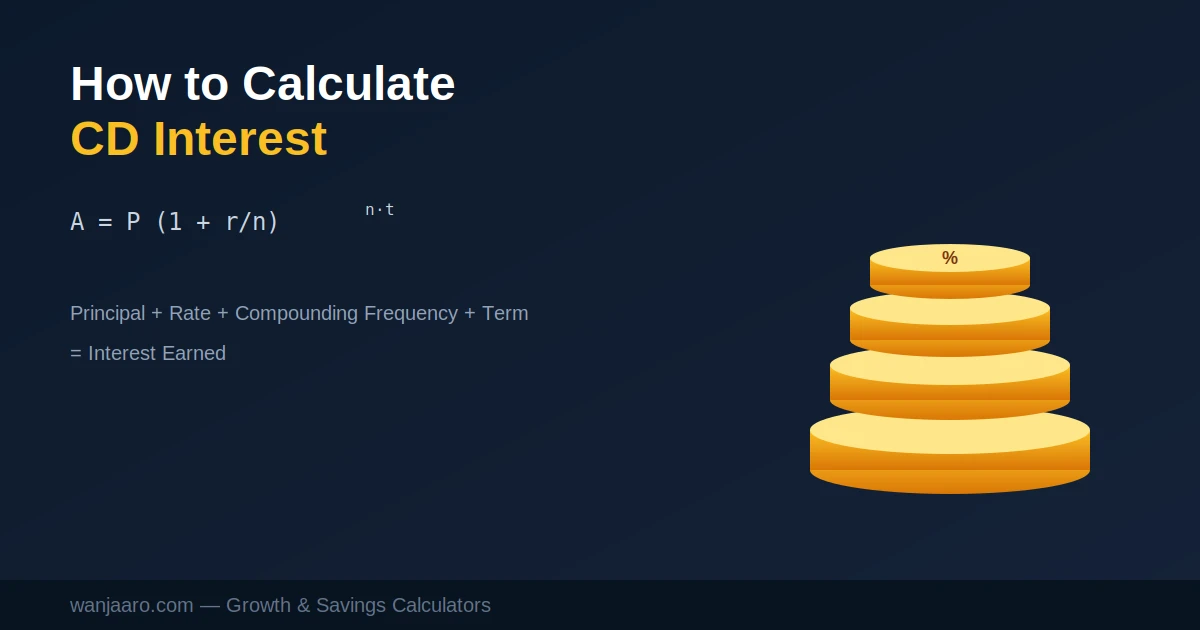
Opening a certificate of deposit is one of the simplest ways to earn a guaranteed return on your money — but the number printed on the bank’s rate sheet doesn’t always match what you actually end up with. Whether you’re wondering how to calculate CD interest, how CD rates are calculated, or how much a $10,000 CD will earn in a year, the math comes down to one core formula, applied consistently.
This guide walks through exactly how CD interest is calculated, how compounding frequency changes your total earnings, how to figure APY on a CD versus the stated rate, and how to work out your own numbers manually or with a calculator.
How CD Interest Is Calculated: The Core Formula
A CD (Certificate of Deposit) pays compound interest, meaning interest is calculated periodically and added back to your balance, so future interest is earned on a growing amount rather than just your original deposit.
The formula banks use is the standard compound interest formula:
A = P × (1 + r/n)^(n × t)
Where: - A = the final amount (your CD’s maturity value) - P = principal (your initial deposit) - r = annual interest rate (as a decimal) - n = number of compounding periods per year (daily = 365, monthly = 12, quarterly = 4) - t = term length in years
To find the interest earned rather than the total balance, simply subtract the principal from the final amount:
Interest Earned = A − P
Worked Example: How Much Interest Will a $10,000 CD Earn?
Let’s put real numbers through the formula. Suppose you deposit $10,000 into a 12-month CD at a 5% APY, compounded monthly.
- P = $10,000
- r = 0.05
- n = 12
- t = 1
A = 10,000 × (1 + 0.05/12)^(12×1) = $10,511.62
Interest earned = $511.62
Here’s how that same $10,000 CD plays out across different common terms at a flat 5% rate, compounded monthly:
| CD Term | Principal | Interest Earned | Maturity Value |
|---|---|---|---|
| 6 months | $10,000 | $252.62 | $10,252.62 |
| 1 year | $10,000 | $511.62 | $10,511.62 |
| 2 years | $10,000 | $1,049.41 | $11,049.41 |
| 3 years | $10,000 | $1,614.72 | $11,614.72 |
| 5 years | $10,000 | $2,833.59 | $12,833.59 |
Notice the interest earned isn’t a flat multiple of the term — a 5-year CD doesn’t earn exactly 5 times the 1-year interest, because each year’s interest is compounding on top of the last.
How to Calculate CD Rates and APY
CDs are almost always advertised using APY (Annual Percentage Yield), not a plain interest rate — and this is where a lot of confusion around “how to calculate APY on a CD” comes from.
APY = (1 + r/n)^n − 1
APY already bakes the compounding frequency into a single effective annual number, so you can compare CDs from different banks fairly even if one compounds daily and another compounds monthly. If a bank advertises a CD at 5% APY, that figure already tells you the true one-year return — you don’t need to separately account for compounding on top of it.
This is different from APR, which is the nominal rate before compounding is factored in. For CDs, always compare using APY, since APR alone understates what you’ll actually earn.
Simple Interest on a CD vs. Compound Interest on a CD
Some short-term or promotional CDs are quoted using simple interest rather than compound interest. The simple interest formula is much shorter:
Simple Interest = P × r × t
Using the same $10,000 at 5% for 1 year with simple interest:
Interest = 10,000 × 0.05 × 1 = $500
Compare that to the $511.62 earned under monthly compounding above — the gap ($11.62) is the effect of compounding. It’s small over one year but grows meaningfully over longer terms, which is why almost all standard bank CDs use compound interest rather than simple interest.
How Compounding Frequency Changes What Your CD Earns
Banks compound CD interest at different frequencies — daily, monthly, or quarterly — and the frequency does affect your final payout, even at the same stated rate.
Here’s $10,000 at 5% for 1 year, compared across compounding frequencies:
| Compounding Frequency | Periods per Year (n) | Interest Earned |
|---|---|---|
| Annual | 1 | $500.00 |
| Quarterly | 4 | $509.45 |
| Monthly | 12 | $511.62 |
| Daily | 365 | $512.67 |
The difference between annual and daily compounding on a $10,000 CD is only about $12.67 over a single year — small, but real, and it becomes more noticeable on larger balances and longer terms.
Want to test this with your own numbers instead of doing the math by hand? Our Compound Interest Calculator lets you enter any principal, rate, term, and compounding frequency to see your exact CD earnings instantly.
How Much Will a CD Earn? Quick Reference by Deposit Amount
Using a 5% APY, 1-year CD as a baseline, here’s roughly how much interest different deposit amounts would earn:
| Deposit Amount | Interest Earned (1 year, 5% APY) |
|---|---|
| $1,000 | $51.16 |
| $5,000 | $255.81 |
| $10,000 | $511.62 |
| $25,000 | $1,279.05 |
| $50,000 | $2,558.10 |
| $100,000 | $5,116.19 |
Interest earned scales linearly with your deposit at a fixed rate and term — double the deposit, and you double the interest, since the rate and compounding frequency don’t change.
How to Calculate CD Interest Manually, Step by Step
If you’d rather work it out by hand instead of using a calculator, here’s the process:
- Convert the annual rate to a decimal. A 5% APY becomes 0.05.
- Determine the compounding frequency (n). Check your CD’s disclosure statement — most banks compound daily or monthly.
- Convert your term to years (t). A 6-month CD is 0.5 years; an 18-month CD is 1.5 years.
- Plug the values into A = P × (1 + r/n)^(n×t).
- Subtract your principal from the result to get the interest earned: Interest = A − P.
If your CD’s rate sheet already quotes APY rather than a nominal rate, you can skip the compounding step entirely and use the simpler formula:
A = P × (1 + APY)^t
Since APY already has compounding built in.
What Happens at CD Maturity — and Early Withdrawal
Once your CD reaches maturity, the full principal plus all accumulated interest becomes available to withdraw or roll into a new CD. If you need to access the funds before maturity, most banks charge an early withdrawal penalty, typically calculated as a set number of months’ worth of interest.
Thinking about pulling funds out early? Use our CD Early Withdrawal Penalty Calculator to see exactly how much interest you’d forfeit before deciding.
If you’re managing several CDs with staggered maturity dates to keep some liquidity while still earning higher long-term rates, our CD Ladder Calculator can help you plan the structure and estimate total returns across the ladder.
And if you’re comparing a CD against another rate-based product, our APY vs APR Calculator converts between the two so you’re always comparing offers on equal terms.
FAQ
How do you calculate interest on a CD?
Use the compound interest formula A = P × (1 + r/n)^(n×t), where P is your deposit, r is the annual rate, n is the compounding frequency, and t is the term in years. Subtract your principal from the result to find the interest earned.
How do you calculate APY on a CD?
APY = (1 + r/n)^n − 1, where r is the nominal annual rate and n is the number of compounding periods per year. This gives the effective annual return after compounding.
How much interest will I earn on a CD?
It depends on your deposit amount, the APY, the term length, and the compounding frequency. As a reference, a $10,000 CD at 5% APY compounded monthly earns approximately $511.62 in one year.
How is interest on a CD compounded — daily or monthly?
It varies by bank. Many CDs compound daily, while others compound monthly. Check your CD’s disclosure statement, since more frequent compounding produces slightly higher returns at the same stated rate.
How do you calculate simple interest on a CD?
Simple interest = Principal × Rate × Time. This method doesn’t account for compounding and is used less commonly than compound interest for standard bank CDs.
How much will a CD earn on $10,000?
At 5% APY compounded monthly over 1 year, a $10,000 CD earns about $511.62. At the same rate over 5 years, it earns approximately $2,833.59 due to compounding.
How do you calculate the maturity value of a CD?
Maturity value = P × (1 + r/n)^(n×t). This gives you the total balance — principal plus interest — available when the CD term ends.
Glossary
CD (Certificate of Deposit) — a time deposit account that pays a fixed interest rate in exchange for keeping funds locked in for a set term.
Principal (P) — the initial amount deposited into the CD.
APY (Annual Percentage Yield) — the effective annual return on a CD after compounding has been applied.
APR (Annual Percentage Rate) — the nominal annual rate before compounding is factored in.
Compounding Frequency (n) — how many times per year interest is calculated and added to the CD balance.
Maturity Value — the total amount (principal plus interest) available when a CD’s term ends.
Early Withdrawal Penalty — a fee, usually calculated as a number of months’ interest, charged for withdrawing funds before a CD matures.
This article is for general educational purposes and illustrates standard CD interest calculations. It does not constitute financial advice. Actual CD rates, compounding frequency, and penalty terms vary by bank — confirm specifics with your financial institution before opening an account.