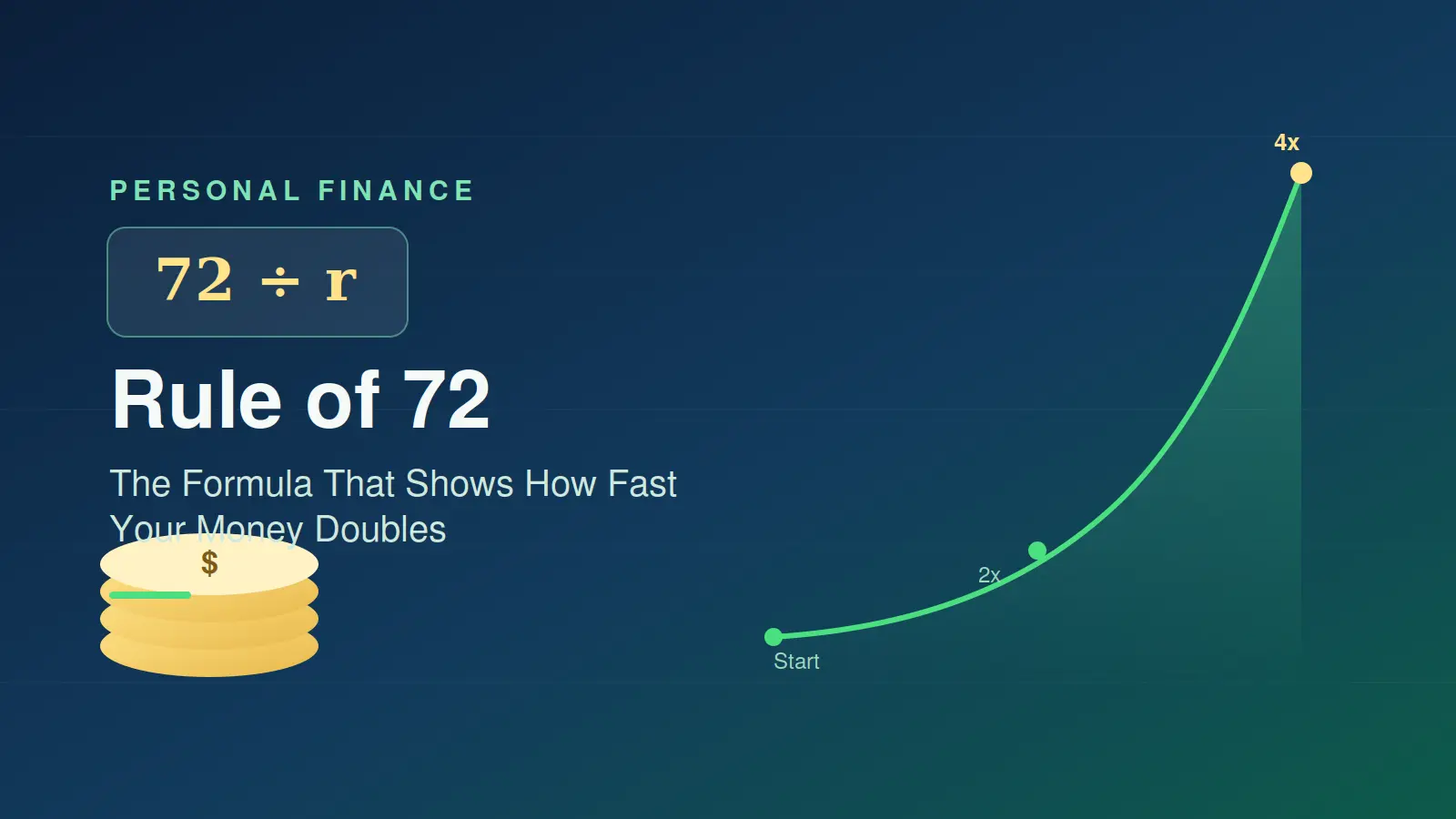
The Rule of 72 is a quick mental shortcut to estimate how long an investment takes to double at a fixed annual rate of return. It is one of the most widely known financial rules of thumb — and for good reason. It is simple, useful, and works reasonably well across a wide range of growth rates.
This guide covers everything: the formula, how it works, real-world examples, why 72 is used, when it breaks down, and a free calculator so you can run your own numbers.
Related Tool: Use our Rule of 72 Calculator to instantly calculate how long it takes for your money to double at any interest rate.
What Is the Rule of 72?
The Rule of 72 states that if you divide 72 by your expected annual rate of return, the result is approximately the number of years it takes for your investment to double.
In simple terms:
Years to double = 72 ÷ Annual Rate of Return
For example, if you earn a 6% annual return, your money doubles in about 12 years (72 ÷ 6 = 12). At 8%, it takes about 9 years. At 12%, it takes about 6 years.
The rule is not exact — it is an approximation. But for quick mental math, it is remarkably accurate.
The Formula
The Rule of 72 is derived from the compound interest formula. Here is how it works under the hood.
Compound Interest Formula
The standard compound interest formula is:
A = P × (1 + r)ⁿ
Where: - A = future value - P = principal (initial investment) - r = annual interest rate (as a decimal) - n = number of years
To find how long it takes to double, set A = 2P:
2P = P × (1 + r)ⁿ
Cancel P on both sides:
2 = (1 + r)ⁿ
Take the natural logarithm (ln) of both sides:
ln(2) = n × ln(1 + r)
Solve for n:
n = ln(2) ÷ ln(1 + r)
Since ln(2) ≈ 0.693, the exact formula is:
n ≈ 0.693 ÷ ln(1 + r)
Where 72 Comes From
The natural log formula uses 0.693, which is close to 0.72 — and 72 is a more convenient number to work with mentally because it has many divisors (1, 2, 3, 4, 6, 8, 9, 12, 18, 24, 36, 72).
Related Tool: See the math in action with our Rule of 72 Calculator — enter any rate and get the exact doubling time instantly.
| Rate | Exact Years (ln formula) | Rule of 72 | Difference |
|---|---|---|---|
| 2% | 35.0 | 36.0 | +1.0 |
| 4% | 17.7 | 18.0 | +0.3 |
| 6% | 11.9 | 12.0 | +0.1 |
| 8% | 9.0 | 9.0 | 0.0 |
| 10% | 7.3 | 7.2 | -0.1 |
| 12% | 6.1 | 6.0 | -0.1 |
| 15% | 5.0 | 4.8 | -0.2 |
| 20% | 3.8 | 3.6 | -0.2 |
The Rule of 72 is most accurate between 4% and 12%, which covers most common investment return assumptions.
Use our **Rule of 72 Calculator to get precise doubling time for any rate.**
How to Use the Rule of 72
Using the rule is simple — just divide 72 by your expected annual return.
Three Common Uses
| Scenario | Calculation | Result |
|---|---|---|
| Stocks (7% return) | 72 ÷ 7 | ~10.3 years to double |
| Bonds (4% return) | 72 ÷ 4 | ~18 years to double |
| High-growth (15% return) | 72 ÷ 15 | ~4.8 years to double |
Reverse Use: Find the Rate You Need
You can also flip the formula to find what rate you need to double your money in a set number of years.
Rate = 72 ÷ Years
| Goal | Calculation | Rate Needed |
|---|---|---|
| Double in 10 years | 72 ÷ 10 | 7.2% |
| Double in 5 years | 72 ÷ 5 | 14.4% |
| Double in 3 years | 72 ÷ 3 | 24% |
Examples
Example 1: Stock Market Investment
You invest $10,000 in a diversified stock portfolio earning an average annual return of 8%.
Rule of 72: 72 ÷ 8 = 9 years
Your money doubles to $20,000 in approximately 9 years.
Example 2: High-Interest Savings Account
You put $5,000 into a high-interest savings account earning 3% per year.
Rule of 72: 72 ÷ 3 = 24 years
Your money doubles to $10,000 in approximately 24 years.
Example 3: Cryptocurrency Investment
You invest $2,000 in a crypto asset earning 25% annual return.
Rule of 72: 72 ÷ 25 = 2.9 years
Your money doubles to $4,000 in approximately 2.9 years.
Example 4: Retirement Savings
You have $50,000 saved for retirement earning 9% annual return.
Rule of 72: 72 ÷ 9 = 8 years
Your money doubles to $100,000 in approximately 8 years, then to $200,000 in another 8 years (16 years total).
Why the Rule of 72 Works
The rule works because of the mathematics of exponential growth. Compound interest grows your money not linearly, but exponentially — and the natural logarithm of 2 is about 0.693, which is conveniently close to 72%.
The Rule of 72 is essentially a simplified version of the natural log formula, rounded to make mental math easier.
Limitations of the Rule of 72
The Rule of 72 is a useful shortcut, but it has limitations.
| Limitation | Explanation |
|---|---|
| Only an approximation | It gives a close estimate, not an exact number. |
| Most accurate between 4–12% | Outside this range, the error increases. |
| Assumes a fixed rate | Real-world returns vary year to year. |
| Does not account for taxes | Taxes reduce your actual return. |
| Does not account for inflation | Your purchasing power may not double even if your nominal dollars do. |
| Not for negative returns | The rule does not work for losses. |
Use our **Rule of 72 Calculator for precise results.**
Rule of 72 vs. Rule of 70 vs. Rule of 69
There are other versions of the rule, each with slightly different accuracy.
| Rule | Formula | Best Used For |
|---|---|---|
| Rule of 72 | 72 ÷ Rate | Most common, good for 4–12% rates |
| Rule of 70 | 70 ÷ Rate | Better for lower rates (2–6%) |
| Rule of 69 | 69 ÷ Rate | Most accurate for continuous compounding |
The Rule of 72 is the most widely used because it is the easiest to work with mentally.
Frequently Asked Questions
What is the Rule of 72 in simple terms?
The Rule of 72 is a quick way to estimate how many years it takes for an investment to double. Just divide 72 by your annual rate of return.
How do you calculate the Rule of 72?
Divide 72 by the annual interest rate. For example, at 6% return: 72 ÷ 6 = 12 years to double.
Why is 72 used in the Rule of 72?
72 is used because it has many divisors (1, 2, 3, 4, 6, 8, 9, 12, 18, 24, 36, 72) and is close to the natural logarithm of 2 (0.693) multiplied by 100.
Can you double your money in the stock market?
Historically, the stock market has returned an average of about 7–10% per year. At 7%, the Rule of 72 says it takes about 10.3 years to double. At 10%, it takes about 7.2 years.
Does the Rule of 72 include taxes?
No, the Rule of 72 does not account for taxes, fees, or inflation. Your actual returns may be lower.
Is the Rule of 72 accurate?
The Rule of 72 is accurate within about ±1 year for rates between 4% and 12%. Outside that range, the error increases.
What is the Rule of 72 formula?
The formula is: Years to Double = 72 ÷ Annual Rate of Return
Can I use the Rule of 72 for debt?
Yes, you can use it to see how quickly your debt doubles if you do not pay it off. For example, credit card debt at 18% doubles in 4 years (72 ÷ 18 = 4).
What is the difference between Rule of 72 and Rule of 70?
The Rule of 70 is slightly more accurate for lower interest rates (2–6%), while the Rule of 72 is more accurate for common rates (6–12%).
Who created the Rule of 72?
The Rule of 72 has been attributed to Italian mathematician Luca Pacioli in his 1494 book “Summa de Arithmetica.” It has been used by investors for centuries.
Summary
| Key Point | Explanation |
|---|---|
| What it is | A quick way to estimate how long an investment takes to double. |
| Formula | Years to double = 72 ÷ Annual Rate of Return. |
| Best for | Rates between 4% and 12%. |
| Limitations | Approximation only, ignores taxes and inflation. |
| Related Tools | Use the Rule of 72 Calculator to get exact results. |
This article is for educational and informational purposes only. It does not constitute financial advice. Past performance does not guarantee future results. Always consult a qualified financial professional before making investment decisions.
Related Tools: - Compound Interest Calculator — See how compound interest grows your money over time. - US Inflation Calculator — Understand how inflation impacts your purchasing power. - Rule of 72 Calculator — Calculate exact doubling time for any rate.