Every online compound interest calculator is doing the same handful of arithmetic steps behind the scenes. Once you know how to work out compound interest by hand, you’ll never wonder again whether a tool is quietly getting your numbers wrong — you’ll be able to check it yourself in under a minute.
This guide walks through the formula, the manual math, a full worked example, and the most common places people go wrong when they try to calculate compound interest without a calculator.
What Is Compound Interest, Really?
Compound interest is interest calculated on both your original principal and the interest that’s already been added to it. That’s the whole idea in one sentence — but it’s worth sitting with, because it’s the entire reason compound growth accelerates over time.
With simple interest, you earn (or owe) the same dollar amount every period, because it’s always calculated on the original principal. With compound interest, each period’s interest gets folded back into the balance, so the next period’s interest is calculated on a slightly bigger number. Do that enough times, and the growth curve stops looking like a straight line and starts curving upward.
That’s also exactly why so many people ask how do you calculate compound interest in the first place — the moment interest starts earning interest, mental math stops being enough, and you need a repeatable method.
The Compound Interest Formula
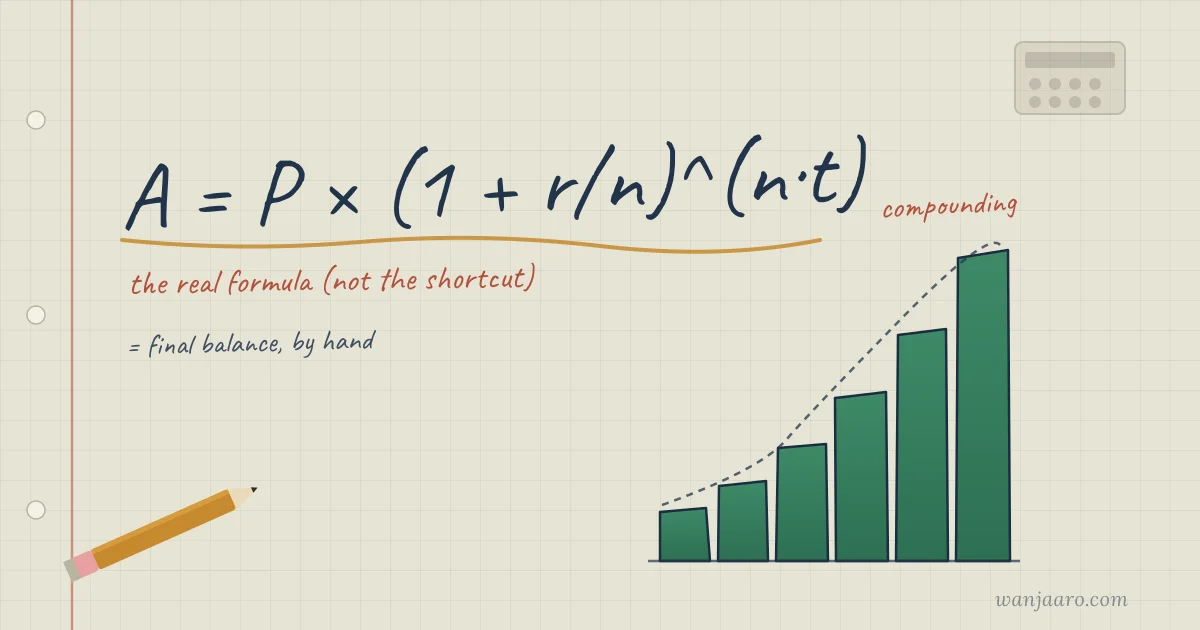
Here’s the formula every calculator — including ours — is built on:
A = P × (1 + r/n)^(n×t)
Where: - A = the final amount (principal + all accumulated interest) - P = the principal (your starting amount) - r = the annual interest rate, written as a decimal (5% becomes 0.05) - n = the number of times interest compounds per year (1 = annually, 12 = monthly, 365 = daily) - t = the number of years the money grows
Once you have A, the interest earned on its own is simply:
Interest = A − P
That’s it. Everyone asking how to compute compound interest, how to determine compound interest, or how do you find compound interest is really just asking how to plug numbers into this one formula correctly — which turns out to be where most manual calculations go wrong.
Related Tool: Once you’ve done the math by hand and want to double-check it (or run it for a dozen different scenarios in seconds), try our Compound Interest Calculator.
Breaking the Formula Down Step by Step
If formulas make your eyes glaze over, here’s the same idea without the symbols.
Step 1 — Turn the rate into a decimal. A 6% rate is 0.06. This single step trips up more people than any other part of the calculation — more on that below.
Step 2 — Divide the rate by the number of compounding periods per year. If interest compounds annually, you skip this (n = 1). If it compounds monthly, divide the annual rate by 12.
Step 3 — Add 1. This turns your periodic rate into a “growth multiplier” — the factor your balance gets multiplied by each period.
Step 4 — Raise that multiplier to the power of the total number of compounding periods. This is the number of years multiplied by how many times per year interest compounds — so 5 years of monthly compounding is 60 periods, not 5.
Step 5 — Multiply by your principal. That gives you the final balance. Subtract your original principal to isolate the interest earned.
Doing these five steps in order is really the whole answer to how to calculate compound interest by hand — there’s no shortcut hiding underneath it, just careful order of operations.
A Full Worked Example
Let’s say you deposit $5,000, at an annual interest rate of 6%, compounded once per year, for 3 years.
| Step | What You’re Calculating | Result |
|---|---|---|
| 1 | Convert rate to decimal: 6% → | 0.06 |
| 2 | Since compounding is annual, r/n = 0.06 ÷ 1 | 0.06 |
| 3 | Add 1: 1 + 0.06 | 1.06 |
| 4 | Raise to the power of n×t = 1 × 3 | 1.06³ = 1.191016 |
| 5 | Multiply by principal: $5,000 × 1.191016 | $5,955.08 |
Your balance after 3 years is $5,955.08, meaning you’ve earned $955.08 in interest — not the $900 you’d get with simple interest on the same numbers. That $55.08 difference is the compounding effect at work, and it only gets bigger the longer the money sits.
Year-by-year, so you can see it build:
| Year | Starting Balance | Interest Earned (6%) | Ending Balance |
|---|---|---|---|
| 1 | $5,000.00 | $300.00 | $5,300.00 |
| 2 | $5,300.00 | $318.00 | $5,618.00 |
| 3 | $5,618.00 | $337.08 | $5,955.08 |
Notice the interest earned goes up every year, even though the rate never changes. That’s the mechanism behind every answer to how do you compound interest — the base you’re earning on keeps growing.
How to Calculate Compound Interest With Different Compounding Frequencies
This is where most manual calculations quietly go wrong. The formula doesn’t change — but n and t need to line up with the compounding frequency, not just the number of years.
Take that same $5,000 at 6%, but compounded monthly instead of annually, for 3 years:
- r/n = 0.06 ÷ 12 = 0.005
- n×t = 12 × 3 = 36 periods
- A = $5,000 × (1.005)^36 ≈ $5,983.40
Compare that to $5,955.08 for annual compounding on identical numbers. Same rate, same principal, same term — but monthly compounding earns you an extra $28.32, simply because interest gets added to the balance twelve times a year instead of once. This is the core answer to how is compound interest calculator logic actually built: frequency is a variable, not a footnote.
How to Calculate Compound Annual Growth Rate (CAGR)
A closely related question is how to calculate compound annual growth rate — useful when you know a starting value and an ending value, but not the rate that got you there (common with investment portfolios or business revenue).
CAGR = (Ending Value ÷ Beginning Value)^(1/n) − 1
If an investment grew from $10,000 to $14,000 over 5 years:
- $14,000 ÷ $10,000 = 1.4
- 1.4^(1/5) ≈ 1.0696
- 1.0696 − 1 = 0.0696, or 6.96% average annual growth
This is effectively the compound interest formula run in reverse — instead of solving for the ending amount, you’re solving for the rate that explains it. It’s the same logic behind how to calculate compounded growth rate or how to calculate compounding growth rate for anything that grows on itself over time, not just savings accounts.
Common Mistakes People Make Calculating Compound Interest by Hand
Forgetting to convert the percentage to a decimal. Plugging in “6” instead of “0.06” inflates the result by orders of magnitude, and it’s the single most frequent error in manual calculations.
Mismatching n and t. Using “3” for the exponent when interest compounds monthly over 3 years — instead of 36 — is an easy slip that produces a wildly understated result.
Rounding too early. Rounding the periodic rate or the growth multiplier before raising it to a power compounds the rounding error itself, which defeats the purpose of the calculation.
Confusing compound interest with simple interest. If a problem says “simple interest,” the compound formula will give you the wrong (higher) answer — and vice versa.
Ignoring additional contributions. The formula above assumes a single lump-sum deposit. If you’re adding money regularly (like a monthly savings contribution), you need a separate annuity-style calculation layered on top — a plain compound interest formula alone won’t capture it.
Why Learn the Manual Method If Calculators Exist?
Because understanding how to figure out compound interest by hand is what lets you sanity-check any tool — including ours. If a calculator ever gives you a number that seems off, you now have the five-step process to verify it yourself in under a minute.
That said, once you trust the mechanics, there’s no reason to redo this math by hand every time you want to compare a savings account, a loan, or an investment scenario. Our Compound Interest Calculator runs the exact formula above — instantly, for any principal, rate, frequency, or term — so you can focus on comparing outcomes instead of re-deriving the arithmetic.
FAQ
How do you calculate compound interest?
Convert the annual rate to a decimal, divide it by the number of compounding periods per year, add 1, raise that to the power of the total number of periods, then multiply by the principal. Subtract the principal from the result to get the interest earned.
How do I calculate compound interest without a calculator?
Follow the same formula — A = P × (1 + r/n)^(n×t) — using long multiplication and repeated squaring for the exponent. It’s slower than a calculator, but it’s exactly the same math, just done manually.
How to calculate cumulative interest over multiple years?
Cumulative interest is simply the final amount (A) minus the original principal (P), after running the compound interest formula for the full number of years you’re interested in.
How to calculate accumulated interest month by month?
Set n to the number of compounding periods per year (12 for monthly) and calculate A after each period, or use the formula directly with the total number of months as your exponent.
How do you calculate the compound interest if the rate changes partway through?
Run the formula separately for each period at its own rate, using the ending balance from one period as the starting principal for the next — you can’t apply a single blended rate across the whole term and expect an accurate result.
How to calculate complex interest with multiple deposits?
A single compound interest formula only handles one lump-sum deposit. For multiple deposits over time, each deposit needs its own compound interest calculation based on how long it’s been invested, and the results are added together.
Is there a simple way to check what a compound interest calculator is doing?
Yes — plug your same principal, rate, frequency, and term into the formula by hand using the five steps above. If your manual result matches the calculator’s output, you can trust the tool for future calculations.
Glossary
Principal (P) — the original amount of money before any interest is added.
Compounding Frequency (n) — how many times per year interest is calculated and added to the balance (annually, monthly, daily, etc.).
Term (t) — the total length of time, in years, that the money grows.
Periodic Rate — the interest rate applied to a single compounding period, calculated as the annual rate divided by n.
CAGR (Compound Annual Growth Rate) — the constant annual rate that would explain the growth from a starting value to an ending value over a given number of years.
Simple Interest — interest calculated only on the original principal, with no compounding.
This article is for general educational purposes and illustrates the standard compound interest formula used in personal finance. It is not financial advice — actual account terms, compounding schedules, and rates vary by institution, so confirm the specifics of any real account or investment with your bank or financial advisor.